I have decided to end this blog. I have used it mostly to detail my college adventures, and now I'm done with college. Besides, I have never been that great about posting often here--I went ahead and posted a draft post that I tried to finish two or three times and never did. Thank you to everyone who has read my blog and found something of interest here.
However, just because I will no longer write on this blog does not mean that I am done blogging! (I know, I know--you're thinking, "Hurray!") I recently came up with the idea to read all of Charles Dickens's books--in one year. I started reading last night. Check out my new blog page here and in the first post I explain more about my idea and vision for this new blog. I hope you will check it out!
Tuesday, August 5, 2014

Long Time No Blog
Sometimes I forget that I have a blog. Oh well.
I'm now in my last semester at Biola. Soon I will no longer be a student--that's a strange feeling. I'm sure I will be really sad come graduation time (I still remember driving around my sister's college on her graduation day as she bawled her eyes out), but right now, I'm just ready to be done. I am enjoying my last semester though. I have the least amount of units I have ever taken (twelve), and I love most of my classes. I like all of them. (There is a difference.)
I'm still going to my internship once a week and getting published there. Last semester, I did a school project and wrote for the online blog Evangelical Outpost. This semester, I'm spending my spare time researching and applying to jobs. I decided that I want to stay in Los Angeles for a little while longer, so I'm mainly looking at jobs in the area. My roommate Elsa and I are planning on still living together. We both want to continue attending our church so we're looking for housing near there, since neither of us has a permanent job yet. I could definitely use prayer for guidance as I apartment search and job search.
Something I've been thinking about lately
I'm now in my last semester at Biola. Soon I will no longer be a student--that's a strange feeling. I'm sure I will be really sad come graduation time (I still remember driving around my sister's college on her graduation day as she bawled her eyes out), but right now, I'm just ready to be done. I am enjoying my last semester though. I have the least amount of units I have ever taken (twelve), and I love most of my classes. I like all of them. (There is a difference.)
I'm still going to my internship once a week and getting published there. Last semester, I did a school project and wrote for the online blog Evangelical Outpost. This semester, I'm spending my spare time researching and applying to jobs. I decided that I want to stay in Los Angeles for a little while longer, so I'm mainly looking at jobs in the area. My roommate Elsa and I are planning on still living together. We both want to continue attending our church so we're looking for housing near there, since neither of us has a permanent job yet. I could definitely use prayer for guidance as I apartment search and job search.
Something I've been thinking about lately
Saturday, June 21, 2014
Homesick Holidays: Why Long-Distance Relationships Are Good For You
(This post was originally posted on www.evangelicaloutpost.com on December 12, 2013.)
One of the hardest things about life is being away from the people you love. This sort of pain does not heal with time; it only gets worse. However, one of the best ways to grow, as a person and as a Christian, is by being away from those same people.
You are bound to experience the pain of separation at some point or another – so you might as well make the best of it. For example, when you’re growing up and trying to figure out what kind of a person you are, it helps to have physical distance between yourself and the people who have always defined you. If you’ve only ever lived relying on your family or close friends to help you make decisions, then maybe it’s time for you to leave home and learn what it means to rely solely on God. Don’t be afraid of forging a new path for yourself, whether by going off to college, moving to a new job, or you getting a fresh start in a new place.
Because the world isn’t perfect, Jesus had to spend time separated from His Father. It was painful and unpleasant, but it was necessary for our salvation. You feel some of that pain when you’re separated from loved ones, and you become more like Jesus because of it. Thankfully, as Christians, we can never be separated from God; we will never experience the same pain that Jesus felt. Striking out on your own somewhere, even if just for a little while, allows characteristics you’ve never seen in yourself to come out. It requires you to build your identity around Christ. Yes, we were made to live in a loving community of fellow-believers, and I’m not suggesting you go live by yourself on a deserted island. You need people around you who will go see new movies with you, who will spontaneously bring you food from your favorite restaurant, and who know when you’ve had a good or bad day. You need those relationships no matter where you are. But when you’re always around the same people, when relationships are easy, how well do you really know the people you’re spending time with? How well do you really know yourself? If a relationship, any relationship, can last through hundreds of miles between two people, than the bond that keeps them together can only grow stronger.
I had many childhood friends that I went to school and church with who I felt close to growing up. Only one friend stuck with me through the years and asked me to be a bridesmaid in her wedding. She was the one who lived 800 miles away and I only saw twice a year. We went to school together from kindergarten to second grade, and then her family moved away. But we wrote letters to each other and her grandparents lived down the street from my house. We relished the time that we could physically spend together, and it made both of us appreciate the friendship all the more.
As the holiday season approaches us, I’m reminded of the distance between my family and me. We measure that distance by time – I’m three hours away from my parents and oldest sister, nine hours away from my other sister, and sixteen hours away from my third sister. This distance, though painful, has actually brought us closer together as a family and has brought each of us closer to God in our own way. It forces you to put effort into a relationship, to actually take time to talk to someone and understand how they are doing, not just casually ask them “how are you?” at the end of each day. The distance isn’t permanent, and I’m not suggesting your relationships should always be long-distance. Jesus was only separated from God for three days. We learn something different about people when we are constantly living beside them, and we need those people. But we shouldn’t be afraid of long-distance relationships, either. Relationships can survive and grow through the distance.
So go to another state, another country. See new sights. Experience new adventures. Email, Skype, and call the ones you love. And when you get back to them, your relationship will be stronger because of the distance that was between you.
Why We Can’t Understand Ten Thousand
(This post was originally posted on www.evangelicaloutpost.com on December 9, 2013.)
Friday, November 8, began as a normal day for Eduardo Jabulan and his wife, but it ended with tragedy. They live in the Philippines, and when Typhoon Haiyan hit their city that day, they struggled to survive along with many others. They lost their three daughters that day, aged three, seven, and eight, but they also lost their way of living. They’ve been unable to grieve properly because they’ve been trying to find food and water and simply survive for the past two weeks.
This horrific typhoon wounded and affected millions, while the number of dead was feared to be more than ten thousand. I read the news and my heart ached for these people that I didn’t know – what a terrible tragedy for them to deal with. But then I went back to my homework or Facebook and moved about my day. I imagine that many people were able to move on, considering that my day proceeded normally and not as if a part of the world had just been shattered.
When a tragedy affects this many people, it’s harder to feel personally connected to those people than when a tragedy only affects a small number of people. When we’re able to see faces with names, we feel the need to mourn with the grieving families and offer any help or assistance that we can give. But when all we see is a number, we can’t process the tragedy in the same emotional way.
For me, ten thousand is too big of a number to grasp. It’s hard to get your head around a number that big. You can raise your eyebrows and say, “Wow!” but do you really know what ten thousand means or what ten thousand looks like?
Ten thousand dollars buys a diamond necklace with 14k white gold. Each neuron in the brain is connected to ten thousand other neurons. There are approximately ten thousand different species of birds. In the Pixar movie Up, Carl attaches ten thousand balloons to his house to make it fly. A mobile home weighs about ten thousand pounds. Multiply ten thousand by 390 and you’ll get the number of people living in Los Angeles.
Though knowing these facts may help, ten thousand can still just seem like a large number. When we’re faced with a staggeringly large number of people affected by a tragedy, it’s important to remember that these are people we’re talking about. They each have a name and a face and a story. Ten thousand stories. Ten thousand laughs. Ten thousand smiles. Ten thousand hands to hold. Ten thousand first steps. Ten thousand first kisses. Ten thousand awkward teenage years. Ten thousand dreams. Ten thousand lives. And they all died in an instant.
Thankfully, the ten thousand originally estimated dead was wrong. As of this writing, the estimate was around 3,500 dead. Though considerably less than ten thousand, this number is still an unattainable number. We can’t put faces and names to all of those people, but even so, we have to remember that they were people, too, who lived with their own hopes and dreams that the typhoon took right along with their lives.
When we’re faced with an impossibly large number like this, we still need to mourn and grieve with the families, even if we don’t see their faces or know their names. We can pray for the unnamed, and the stories that were cut short. Even though ten thousand people did not die, more than eleven million were affected, including Eduardo Jabulan and his family, in physical and emotional ways. There are ways we can help them. Though not everyone can travel to the Philippines and lend a physical hand, everyone can donate a few dollars and help others to lend hands. My sister has worked with the organization Kids International Ministries in the Philippines on a number of missions trips. KIM is sending a team of nurses along with other aid and relief to Tacloban, the city most affected by the typhoon and the city where the Jabulans live. You can donate to their causehere. There are also a number of other organizations you can donate to in order to send support to those in need. Check them out here.
Maybe we can’t quite grasp the number ten thousand. But we can remember the lives of those lost by helping those still living, like the Jabulans, who do see the faces and know the names of the dead. And maybe if we learn a few of those names, we can come to a better understanding of ten thousand.
God the Storyteller: Why We Should Value Happy Stories
(This post was originally posted on www.evangelicaloutpost.com on December 4, 2013.)
Have you ever read a poem or a story, eagerly awaiting that climactic, often tragic, moment, only to find it never comes? Most likely you thought How boring! and quickly moved on from the happy tale. There are not many of these happy stories in existence, mainly because it’s easier to write tragic stories. It’s harder to make a story interesting when it’s about a happy ordinary person, than when it’s about a troubled or sad ordinary person.
It’s like Leo Tolstoy’s opening line in his great novel Anna Karenina: “Happy families are all alike; every unhappy family is unhappy in its own way.”
When people are happy, it’s usually for the same reasons – they have a great job, their family is still together and loving, they have great friends, everything is going well. But people who are unhappy, those who we write tragic stories or poems about, they are never unhappy for the same reason – and that’s what makes the story interesting.
When I was younger, I used to wish that something tragic would happen to me – a car accident or a kidnapping (always with happy endings, of course) – because I wanted my life to be more interesting. I wanted my life to be a story that other people would want to read. I had a pretty normal life growing up, so I thought that if something unusual happened, my life would be better. I was dissatisfied with living a happy, normal life, and I suspect I’m not the only one who has ever felt that way.
But what does this feeling say about our view of God?
We don’t like stories that don’t have some tragic element in them, yet God is the ultimate storyteller, and He is writing each of our lives’ stories. Each life is unique, but there are those that aren’t tragic – the ones that we think are boring. But God is deeply interested in even those boring stories. He wrote them, so how can He think they are boring? How can any of our lives be boring or dull or normal with God as the author?
Have you ever thought that you could write your life story better than God can? This is just because you do not know what coming. Think back on the past ten years of your life. Did you ever see yourself where you are today? Chances are, you didn’t, and maybe you see that as a good thing but maybe you see that as a bad thing. Either way, you could never have orchestrated your life to land you where you are today. And you can’t work out all the details and direct your life to where it will be in another ten years. You don’t see how your life relates to other people’s live or how their lives relate to yours – you don’t see the big picture. You can’t know the best way your life can play out. Only God does. And you can’t judge His writing because you don’t know the ending yet. Your favorite part in the story could still be yet to come.
So how can we trust God to write our stories in the most interesting way possible? I thank God that I haven’t experienced any major tragedies in my life, but sometimes I still feel like my life, if written down, would make a boring story. Trust is hard, especially when you feel disappointed with life. But perhaps it would be easier if we realized that all of those happy families that Tolstoy mentions arenot all alike. They may be similar, but God has made each one unique in some way – and He is interested in each one. If we were more interested in the stories and poems that describe happy, normal people – if we tried to figure out what made them unique in their happiness – maybe then we would also be interested in our seemingly mundane lives. God wants us to be happy; it’s not a bad thing, yet we treat happy people as if they weren’t interesting people. God doesn’t create boring stories, and He has authored each of our lives. We should live life trusting God with that job, and we should treat other people’s lives as a manifestation of His great creativity.
Villainy and Valor: The Superhero Obsession
(This post was originally posted on www.evangelicaloutpost.com on November 5, 2013.)
From Batman to Iron Man, Superman to Spiderman, our society has become obsessed with superheroes. It’s not just a kid thing anymore. Whether it’s because of the special effects or the romantic elements, people flock to the theaters for any movie that involves a caped (or suited) crusader risking his (or her) life to save those he loves. The good guy always learns responsibility and self-sacrifice, and, though all hope may seem lost, he always wins. So why is it that everyone loves these somewhat predictable and unrealistic movies so much?
Perhaps people love these movies exactly because they are predictable and unrealistic. The way the good guy saves the day might not always be the same, but the fact that the day will be saved remains true. Even the bad guys are usually pretty similar – they all feel betrayed and persecuted in some way and sulk behind a cloak of lies while they plot for some kind of world dominion and power. These movies provide two and a half hours of escape from an unpredictable and depressing world. Real life can be disappointing for many people, and reading the news every day can be discouraging. Superhero movies give people the chance to feel optimistic about life. The day can be saved and the villain can be conquered; that promotion can be acquired and that bully can be put in his place. But then they go to work the next day and remember that superheroes aren’t real and that if they want the day saved, they have to do it themselves.
The obsession with superheroes has only increased over the years as more and more people want to have something, or someone, to put their hope in as they live in this selfish and sad world. Each new day seems to bring a new tragedy – school shootings, terrorism, shipwrecks, car accidents – or just the everyday heartache – insufferable bosses, unattainable goals, lost love, too many bills. No one swoops in to carry them away and solve all of their problems. Yet they don’t want to lose hope that that could happen. What they don’t realize is that they do have a hero they can put their hope in, and while he may not be the typical superhero in a flashy suit and cape, he is very real and most definitely will save the day. Of course, I’m talking about Jesus Christ.
I know it may sound cheesy to you, but think about it. All of these superheroes are based on Christ. He fought the first villain and has already won – we just haven’t seen the fruits of it yet. Satan invented bad guys; he challenged the King’s authority and desired world dominion and power for himself – the first to ever do so. Every villain since then has only been an imitation of Satan. Aliens trying to destroy the human race? Satan wanted humans to die, too. Evil genius trying to sneak unnoticed into a position of the upmost power? Yeah, Satan tried that one, too. Powerful manipulator attempting to rule by force? Satan used his legion of fallen angels to try that one. Villains always fail because Satan failed. They can’t win. What makes a villain interesting in the story is the fact that he is human and thus has a chance for redemption, whereas Satan has already sealed his fate.
Likewise, the superheroes are modeled after Christ, though not as perfect. Jesus did not make mistakes, but the superheroes usually do. However, they learn from those mistakes, and, in that knowledge, they become more like Christ, learning to sacrifice and use their gifts for the good of mankind. Superman is perhaps the most obvious hero that is like Christ – not being raised by his real father but still speaking to him, being superior to the human race, always stepping in to save the humans. Thor, too, is seen as a god with superior abilities yet does whatever he can to save the human world. Even those without superpowers eventually take the weight of the world and put it on their own shoulders, promising to do whatever is necessary to save humanity. Sometimes these heroes are even able to come back from death, just like Jesus did, or seeming death (though none are ever dead for three days).
So why do we obsess over superheroes? Perhaps these stories are more realistic than they at first seem; they remind us of our need for a Savior – Jesus Christ. Every human being was created to have a relationship with Jesus Christ and have him be our Savior. When we don’t feel the effects of that, we turn to the next best thing – superheroes. They remind us that good will always defeat evil by doing what we forget Christ has already done. The victory has been won; the enemy has been conquered. Though we don’t know how the day will end or in what ways the villain will attack us, we know that good will prevail over evil in the long run. So when you go to see the new Thor movie or tune in to the new episode of Marvel’s Agents of S.H.I.E.L.D. and you find yourself wishing you lived in a superhero story, remember that you already do. Christ is the ultimate hero, and he will swoop in and save the day – all you have to do is let him.
Loving Your Enemies in Ender’s Game
(This post was originally posted on www.evangelicaloutpost.com on November 1, 2013.)
Jesus commanded us to love our enemies. How can we love them if we don’t understand them, if we don’t take the time to know them? In the novel Ender’s Game by Orson Scott Card, Ender Wiggin unintentionally learns the best way to love one’s enemies, and he never forgets it. Though just a child deprived of a family’s love and friendship, Ender does what most adults can never do – he loves those that society tells him he’s supposed to hate.
Ender’s Game takes place in a distant future, when our world had been almost destroyed in two invasions by an alien race called the buggers. In the second invasion, the humans were able to force the buggers to retreat, though at great cost. They’ve had peace for about 70 years now but have been expecting another attack from the buggers. In preparation for this third invasion, the leaders of different countries created the International Fleet – an army that trains children to fight battles in zero gravity on a spaceship. All children on Earth are closely monitored to see if they are eligible for this Battle School. At age six, Ender, the youngest of three young geniuses, is chosen to leave his family and train to save his world, and the book details his life through training to the end of the war.
Ender always looks at life by thinking three steps ahead, even at age six. His brilliance flourishes in the Battle School, and he quickly advances, accomplishing many feats that children twice his age can’t do. This, of course, causes the other children to be jealous and Ender to feel isolated. The adults in command of the school keep Ender busy with training and mock battles, manipulating and controlling his life so that he has no close friends. They don’t want anything to distract him from his training, not even love, because he is their last hope to destroy the buggers. With the fate of the world on his little shoulders, Ender becomes the best commander the adults have ever seen – a quick thinker, a strategist, a hard worker, and, what they wanted most, a killer.
Ender, however, hates himself for this trait. He is terrified of becoming just like his brilliant but cruel older brother, Peter, who tormented him before Ender left for Battle School. He tries to be compassionate, but what he doesn’t realize is that this is exactly what sets him apart from Peter. Ender doesn’t want to hurt people. Several boys bully him at different points in the novel, but because Ender knows how the other boys think and what is motivating them, Ender defeats the bullies, strategically and systematically. Afterwards, though, he always feels guilty. Ender defeats his enemies because otherwise his enemies would have hurt or killed him; but at the moment that Ender defeats them, he loves them. He feels compassion for them. He understands how to love his enemies and doesn’t want to destroy them. He tells his sister, Valentine:
“In the moment when I truly understand my enemy, understand him well enough to defeat him, then in that very moment I also love him. I think it’s impossible to really understand somebody, what they want, what they believe, and not love them the way they love themselves. And then, in that very moment when I love them…I destroy them” (page 238).
Ender’s greatest quality, the thing that makes him different from all the other children, is not his ability to wipe out his enemy completely but his ability to learn about and understand people, even his enemies. He’s the only one who takes the time to understand them, to know their past and the reasons for their actions. And it’s only when he understands his enemies that he loves them and wants to live at peace. There are two ways to destroy an enemy. One is to defeat through harm. The other way is by turning him into a friend. Ender does not want to destroy his enemies; he would rather befriend them and love them.
Not only does Ender love his human enemies, but he even learns to love the alien enemies, those who almost destroyed his world. Though not instructed to by any adults, Ender spends hours and hours trying to understand the buggers, how they think, why they attacked Earth, and how they live. When he does finally understand them, he doesn’t want to destroy them; he wants to live in peace with them. The adults want him to defeat the buggers and completely wipe them out, but Ender wants to forgive them and be friends. The one person who is able to defeat the buggers is the only human who loves the buggers. I don’t know what the movie version of Ender’s Game teaches, but if there’s one thing you learn from the book, though there is much to learn from it, I hope you learn how to better love those you’re “supposed” to hate.
Racism in America: What You Don’t Know
(This post was originally posted on www.evangelicaloutpost.com on October 28, 2013.)
It will never go away. Even if our country ever divides equally by each race, racism will still abound. The war that Americans fought in the 19th century was not a war to end racism; it was a war to keep America united. The civil rights laws that were passed in the 20th century, though a step in the right direction, were not laws to end racism. Laws cannot end racism; they can only stop the violent effects of racism. So how are we supposed to treat the issue of racism?
The best treatment for the issue of racism that I can think of is described in the movie Remember the Titans, when Coach Boone takes his football players to the Gettysburg battlefield. Based on a true story, Coach Boone was an African American man coaching one of the first high school football teams that had both white and black players in the early 1970’s. He took his team to a football camp for two weeks, but the players had done nothing but hate each other. So he finally makes them wake up at 4 a.m. and run the few miles to the Gettysburg battlefield, where he gives them an inspirational speech of how blacks and whites bled and died on that field over a hundred years earlier, fighting the same fight the football players were fighting. He tells them, “You take a lesson from the dead. If we don’t come together, right now, on this hallowed ground, we too will be destroyed – just like they were. I don’t care if you like each other or not. But you will respect each other.” This is a turning point in the film, as from then on, the boys learn from and respect each other, and they do end up liking one another.
Americans often sweep the issue of racism under the rug today; they assume that we successfully tackled that issue decades ago and, because of that, we no longer need to have conversations about it. People think that the world has moved on from racism, as is evident by the fact that we are now governed by an African American president, and now the LGBT community and debates demand our focus and block other issues from view. While that issue is important, the issue of racism also deserves to be discussed, as it is equally important.
Recently, I read an article from The Evening Sun, a newspaper in Pennsylvania, about a Ku Klux Klan rally in Gettysburg. Three members, dressed in white robes and hoods, stood outside the Gettysburg Borough building and promoted white supremacy. With their identities hidden because of their hoods, they told how they want America’s borders to be closed to immigrants and relayed plans for a future rally at the Gettysburg battlefield.
After reading the article, I was shocked. How can these men go to that battlefield and dishonor those people that died there, fighting the same fight that has already caused much bloodshed? People think racism does not exist because our country fought a war about it in the 1860’s, but they forget that African Americans, though free, did not have many rights until the Civil Rights Act of 1964, exactly one hundred years after the Civil War ended. If it took that long for non-whites to have their basic rights and be respected, then why is it a surprise that racism still exists today, only fifty years later? It shouldn’t be, but I think it is because the media runs around the issue and does not publicize it anymore. Local news writes about it, but that’s as far as the news gets.
People want to think that they tackled the racism issue long ago, that because America is so diverse, there’s barely a majority among the races anymore. Just because America practices diversity does not mean that racism does not exist. During World War II, Americans huddled up other Americans and put them in interment camps simply because they were of Japanese heritage. More recently, after 9/11, Americans threw verbal and physical attacks at people of Middle Eastern heritage, even though they felt just as stunned and kicked-in-the-gut as the rest of the country. What happened was a terrible tragedy and an act of terror, but that does not mean we should turn around and terrorize others. Forcing diversity on people, however, will not lead to a victory over racism either. Employers and college admission directors make sure that their businesses or schools meet the requirements for diversity – a certain percentage African American, a certain percentage Asian, etc. They sleep in peace, feeling that they have done their duty towards diversity and ending racism, but they haven’t. Racism doesn’t end when we meet all the numbers and become a country equally divided among the races. Racism ends when we learn to love one another. Merely looking at the numbers but ignoring the actual people does nothing and can even create more problems.
While we live in this sin-filled world, we will probably never defeat racism. But we should be aware of this issue and not try to deny that it doesn’t exist anymore. We should stop looking at the statistics and start looking at the people. We should learn about, care for, respect, and eventually love them. Only then will we ever successfully stop fighting this battle we’ve fought for over a hundred and fifty years.
Instrumental Music vs. Vocal Music
(This post was originally posted on www.evangelicaloutpost.com on October 16, 2013.)
As I sat and listened to Gustavo Dudamel conduct the renowned Los Angeles Philharmonic in the beautiful Walt Disney Concert Hall, I couldn’t help but look around at the audience. There were a few young adults scattered around but no teenagers and no children. Why is it that attending symphony performances has become an “elderly” thing to do? I understand that these kinds of performances are expensive, but they usually offer student discounts, group rates, and other special offers – all you have to do is plan ahead. Why is it that our generation can pack out the Staples Center for a Taylor Swift concert but can’t manage the time to experience a distinguished conductor with arguably the best orchestra in the country?
Instrumental music used to be all that people listened to, young people included. The music that young people love today and listen to on repeat usually has lyrics attached to it. These lyrics tell a story about some aspect of life, most often romantic love, and they make it clear what the music is about. The main focus is on the lyrics; people listen to it so they can sing along. Obviously, you can’t sing along to instrumental music, and because of that, people often find it boring. However, if they really took the time to listen to it, they might find it more interesting than vocal music. Instrumental music requires us to imagine our own story for the song. The music gives us themes and emotions, but we have to fill in the rest. Sometimes, there is no story, but only a range of emotions the composer wants you to feel. You have to think and focus on the music that you’re listening to; you can’t just follow along with lyrics that you can sing without thinking about. Listening to instrumental music requires more effort, but it has a rewarding payoff that many people miss. Not only do doctors use it to help improve both physical and mental health, but it can also alleviate stress and anxiety. Maybe we wouldn’t be such a busy and stressed society if we listened to instrumental music more.
Everyone knows the names of Bach and Mozart and could probably recognize Beethoven’s famous fifth symphony, but who are the modern-day composers? The ones that compose film scores – Hans Zimmer, Michael Giacchino, John Williams, Howard Shore, to name a few. Most people who do listen to instrumental music today listen to soundtracks. While these compositions are beautiful and creative, they are more similar to popular lyrical songs than other instrumental music. There is already an image and a story attached to these compositions – the one from the movie or television show. They don’t require any new imaginations, but rely on your knowledge of the film.
There’s something about allowing our mind to connect the dots in the music that we don’t want to do. We don’t want to imagine our own images and story for the music that is playing; we want it to be told to us. I’m not saying that there’s anything wrong with lyrical music or film scores; I definitely listen to them more than classical music. But I am saying that there’s a lack of a desire to listen to instrumental music. In this world where we idolize those who can sing, we don’t have enough respect for those who create, conduct, or perform purely instrumental music. Either people weren’t raised on it or they say it bores them and puts them to sleep. But instrumental music, if you’re really listening to it, makes you think and can expand your mind. It forces you to listen to it over and over again so that you can hear each theme and every new emotion and form a complete story or image of your own to match the music. It can calm your nerves and dissipate your stress.
You don’t have to give up vocal music to appreciate instrumental music. But the next time you’re sitting in traffic or needing to unwind a little, try listening to instrumental music. Instead of lulling you to sleep, it could help you focus better than vocal music does, if you let it. If you have a favorite film composer, listen to his music for a film that you haven’t seen and see if you appreciate it as much. I love popular vocal music as well as the next person, but I’ve made a conscious effort to listen to more instrumental music, and my appreciation for it has grown. Not only that, but I’ve found myself less stressed about life in general. My generation assumes that they can’t like instrumental music because it’s not fun or popular, but they are also always busy, expecting every new technology to make their lives easier when it only makes it more stress-filled. If they put the effort in to understand instrumental music, they would discover just the opposite of their expectations and might even be able to relax. Then maybe one day we could sell out a concert hall for a symphony performance and have it filled with people a variety of ages.
Learning to Love Others Through LOST
(This post was originally posted on www.evangelicaloutpost.com on October 7, 2013.)
Though we were made to live in relationships with others, many people go through life alone. They have jobs and friends and interact with others, maybe on a daily basis even, but they never really let anyone close to them. No one knows their secrets, and they face all of their struggles, internal and external, on their own. But this is no way to live. God created us to live in harmony together, helping one another and loving each other through everything. When you already feel that you’re facing life alone, it can be hard to trust others and learn how to be loved, as well as learn how to love others. Yet if you learned this seemingly simple lesson, life would be so much richer. One of the greatest examples of this can be found in the television series LOST.
By understanding the finale, we can begin learning to love others through LOST. When LOST ended in 2010, many people were disappointed and angry with the finale. The writers didn’t answer every single question, and they felt gypped because they’d invested so much into the show and didn’t think the ending was much of a reward. These people, however, missed the whole point of the show. If you asked them what LOST was actually about, they might say, “a plane crash,” “a mysterious island,” “unanswered questions,” “time travel and other sci-fi strangeness,” or something along those lines. While the show incorporates each of those things, that’s not what it’s about. The main point of LOST can be summed up in one word: characters.
From the first episode, LOST focused on the fourteen main cast of characters, with that cast decreasing and increasing throughout the six seasons as some people died and new ones were introduced. The beauty of the show is found in each of these characters, in their trials and heartache, their sorrows and joys. The first season makes this clear through the use of flashbacks. Each episode focuses on one character and uses flashbacks to show why that character is acting the way they are in the present. The flashbacks quickly develop the characters: Jack is the heroic, over-controlling doctor who feels he can never live up to his father; Kate is the always-on-the-run criminal who comes from a broken home; Sawyer is the conman who hates himself as much as he hates everyone around him; Sun and Jin are the married couple who keep so many secrets from each other, they barely talk to one another; Charlie is the drug-addict rock star whose brother ruined his life; Claire is the pregnant, single girl who’s giving the baby up for adoption; Hurley is the overweight funny guy who won the lottery and used to be in a mental institution; Sayid is the romantic torturer who fights his demons almost daily; Locke is the older guy who used to be in a wheelchair and felt he had no purpose in life. Through these flashbacks, we see the reasons for why the characters act the way they do. Through the events on the island, we watch them grow, learn, and change with each other. Fast forward six seasons, and you can barely recognize these characters. They have experienced love and loss, and changed for the better because of their experiences together.
LOST does something that not many other shows can do. It brings together a group of seemingly random people that have nothing to do with one another and forces them to live together. Their ages, nationalities, religions, and experiences are all different; they have no reason to be together other than the fact that they all happened to be on the same plane. They would never have talked to each other if the plane had not crashed. However, they all have one thing in common: they’re alone. They’re alone in their sorrows and sin. They have no one to trust. These “Losties” are truly lost in the world. They could be anyone you see on the street. As they are forced to live together though, they come to know one another. They challenge each other and learn from one another, and, somehow, they learn to love each other. They learn that they need each other, a simple human truth that we could all learn. We need other people. LOST exploits this simple human need: God made us to live in a community with other people who love us, faults and all. The Losties don’t learn this lesson right away – it takes six seasons for them to live it out – but when they do, it’s something beautiful. They each learn how to selflessly love another person.
LOST does contain suspense and mystery – the monster, polar bears, time travel, other people inhabiting the island, etc. It’s not a show that could happen in real life. But the people on the show are real. The mysterious things only aid in developing and growing the characters. Viewers get distracted by those things, and thus they were upset when their questions were not answered in the finale. But that wasn’t the job of the finale. The finale’s job, based on how character-driven the show was, was to give a satisfying ending to those beloved characters in a way that would give credit to all that they had been through. And the finale does just that. It emphasizes why the characters needed each other. It shows you the important moments in their lives and reminds you, the viewer, that you cannot live life alone. You need other people to love and be loved by, just as much as the Losties needed each other.
In the season five finale, one character complains to another about the corruptibleness of humanity, saying, “It always ends the same.” The other character responds, “It only ends once. Everything that comes before is just progress.” This line applies to every life and is illustrated in the lives of the Losties. They make mistakes and feel despair, but they learn and change. They don’t give up on themselves or each other. They learn forgiveness and sacrifice and selfless love. The beauty of the finale is that, though their experiences were strange and unrealistic, the characters’ emotions and growth were very realistic. They didn’t need all of their questions to be answered, they didn’t need the strangeness explained – they only needed to be together and loved. Just like in our lives – we can never have all of our questions answered, but we don’t need them to be. Though LOST is not a Christian show, it has Christian themes, and the finale ends with the most important one in the show. The only way we can survive this life is by living together, demonstrating God’s love by selflessly loving one another.
Monday, August 26, 2013
End of Summer Tidings
I just realized that I never posted about the last two days of my Cambridge trip. My bad. All you really need to know is that we had our last session on Galatians that Friday morning, and then I did some last-minute shopping in Cambridge, took a train to London, and spent the night in the airport with seven friends before my flight left Saturday morning. The flight was uneventful, and though I had a wonderful trip, I was glad to be home with my family again. I should do a reflection post on my trip overall, but that's not what I came to do tonight, so look for that (hopefully) sometime in the near future. :)
I spent two wonderful weeks at home before I came back out here to California. I moved back in (sort of - I lived out of my suitcases) to the house I was subleasing in June and started working in the library again. I was expected it to be a boring three weeks before school started, much like the beginning of the summer. But, thankfully, it wasn't. More of my friends were around, so I was able to do fun things with them (such as seeing The Butler, going to the beach, eating at Chipotle). I also got a babysitting job for a small group at my church that meets most Sundays. And my most exciting news is that I got an internship at a magazine! My last day in Cambridge, I got an email from a small Christian magazine that I'd applied to back in May. The magazine is New Identity Magazine, and I am both the Associate Editor Intern and the Staff Writer Intern. The editor works from her home, so the past three weeks, I drove to Torrance (about 15 miles from here, 30 minutes to an hour) twice a week and helped her edit articles and brainstorm articles and titles, and she has been teaching me about being a magazine editor and what all that entails. She also assigned me an article to write for the next publication, so I will be working on that over the next month. The month of September I will be working this internship from school, but starting in October, I'll be driving to her house again every Friday. I've loved the internship so far, and I'm really excited and grateful for this experience. I even have my own email address - stephanie@newidentitymag.com. :)
This past Saturday, I moved out of the house I was at and moved in to my very first apartment! It's a Biola-owned apartment complex, which is why I couldn't move in until this past Saturday. I absolutely love it! Our kitchen is beautiful and spacious, the living room is roomy (though the couch and two chairs it came with aren't that comfortable), the bedrooms have nice, big closets with full-length mirrors for doors, the bathroom is nice, we have storage space, and there is a pool right outside my door! Needless to say, I have been so excited to move in here, and now that I'm here, I just love it. I unpacked all my stuff Saturday (I don't actually have that much for an apartment). Victoria came Sunday, and the apartment got very cute and colorful! It feels like a home now. Elsa and Hannah come tomorrow morning, and classes start on Wednesday. I have less units this semester than I've ever had before (only 14), but I have my internship, I'll be working 15 hours a week at the library, and I'm hoping to have the time to apply to other internships. I'd love to get one at a publishing company and see what that is like.
I'm really excited for this school year, though I am sad that it is my last year here. I don't know where I'll be after I graduate, but that's okay right now. I have had the best college experience I could have asked for and I know that this year will only add to that as I start blending college life with "real" life (as in, living in an apartment, doing more cooking, having an internship). It won't be time to cry until May. Before then, I hope to make the most of my senior year and enjoy every minute. :)
"Oh, don't say that it's over. Oh, no, say it ain't so. Let's let the stars watch; let them stare. Let the wind eavesdrop; I don't care. For all that we've got, don't let go. Just hold me."
- Eavesdrop, The Civil Wars
I spent two wonderful weeks at home before I came back out here to California. I moved back in (sort of - I lived out of my suitcases) to the house I was subleasing in June and started working in the library again. I was expected it to be a boring three weeks before school started, much like the beginning of the summer. But, thankfully, it wasn't. More of my friends were around, so I was able to do fun things with them (such as seeing The Butler, going to the beach, eating at Chipotle). I also got a babysitting job for a small group at my church that meets most Sundays. And my most exciting news is that I got an internship at a magazine! My last day in Cambridge, I got an email from a small Christian magazine that I'd applied to back in May. The magazine is New Identity Magazine, and I am both the Associate Editor Intern and the Staff Writer Intern. The editor works from her home, so the past three weeks, I drove to Torrance (about 15 miles from here, 30 minutes to an hour) twice a week and helped her edit articles and brainstorm articles and titles, and she has been teaching me about being a magazine editor and what all that entails. She also assigned me an article to write for the next publication, so I will be working on that over the next month. The month of September I will be working this internship from school, but starting in October, I'll be driving to her house again every Friday. I've loved the internship so far, and I'm really excited and grateful for this experience. I even have my own email address - stephanie@newidentitymag.com. :)
This past Saturday, I moved out of the house I was at and moved in to my very first apartment! It's a Biola-owned apartment complex, which is why I couldn't move in until this past Saturday. I absolutely love it! Our kitchen is beautiful and spacious, the living room is roomy (though the couch and two chairs it came with aren't that comfortable), the bedrooms have nice, big closets with full-length mirrors for doors, the bathroom is nice, we have storage space, and there is a pool right outside my door! Needless to say, I have been so excited to move in here, and now that I'm here, I just love it. I unpacked all my stuff Saturday (I don't actually have that much for an apartment). Victoria came Sunday, and the apartment got very cute and colorful! It feels like a home now. Elsa and Hannah come tomorrow morning, and classes start on Wednesday. I have less units this semester than I've ever had before (only 14), but I have my internship, I'll be working 15 hours a week at the library, and I'm hoping to have the time to apply to other internships. I'd love to get one at a publishing company and see what that is like.
I'm really excited for this school year, though I am sad that it is my last year here. I don't know where I'll be after I graduate, but that's okay right now. I have had the best college experience I could have asked for and I know that this year will only add to that as I start blending college life with "real" life (as in, living in an apartment, doing more cooking, having an internship). It won't be time to cry until May. Before then, I hope to make the most of my senior year and enjoy every minute. :)
"Oh, don't say that it's over. Oh, no, say it ain't so. Let's let the stars watch; let them stare. Let the wind eavesdrop; I don't care. For all that we've got, don't let go. Just hold me."
- Eavesdrop, The Civil Wars
Thursday, July 18, 2013
Cambridge Day Sixteen, Seventeen, and Eighteen (July 15th-17th)
Monday, after a refreshing shower and nap from the busy weekend, I attended our last required lecture, by Malcolm Guite. Malcolm Guite gave a lecture at Biola, I think last fall, so I had heard him then, and he was just as great to listen to in England as he was then. He's a poet, and he talked to us about poetry, words, and language. Monday evening, we attended the Cambridge Shakespeare Festival performance of "Much Ado About Nothing," in the gardens/lawn of St. John's College. It was so fun! The actors were really talented, and the setting was just gorgeous. It's hard to compare it to the Globe, because it had such a different feel. I enjoyed both experiences!
We had session Tuesday morning on F.F. Bruce's Paul and the Mind of Christ and John Pollock's The Life of Paul. After session, Heather, Scott, and I took a bus to Oxford to visit the Kilns, C.S. Lewis' home - something we'd planned a while ago. Our tour was at 4pm, and we thought the bus would arrive in Oxford at 3:15pm (it's a three-hour bus ride), but it didn't get there until 3:45pm. Upon getting ready to depart the bus, I noticed a white string on my bag. Turns out, the white string was actually gum. Unfortunately, I happened to not have any Kleenex or tissue with me; all I had was a grocery bag I'd bought my lunch in. I got the gum off as best as I could and tried not to think about where it had been. Anyways, we had to catch another bus to get out to the Kilns, which was a little ways out of the main part of Oxford. This bus was supposed to come every 30 minutes on the half hour, so we thought we'd catch the one at 4pm. It didn't come until 4:15pm. And the driver didn't let us use the bus pass we already had, even though we'd been told we'd be able to (a later bus driver also told us that this guy should have let us!), so we had to buy another ticket. I called the Kilns on the bus to let them know we were late but still coming. We got there at 4:45pm. There was no point in joining the tour because it only lasts an hour, but the gal was really nice and gave us a tour with just the three of us. It was really cool to see the house. They had pictures of C.S. Lewis in the house on the walls that they had used to make the house look how it had looked for him. A few things were still authentic to the house, such as a doorknob, some fireplaces, and an old typewriter that belonged to his brother. After seeing the house and taking lots of pictures, we walked to his grave by his church.


On the bus back into town, we noticed the people behind us were Americans. Scott recognized them as being in the tour that we had missed, so he started talking to them. They're from Tennessee, and so of course, I got involved in the conversation. Turns out, the lady is the assistant director of the honors program at Union University, my second choice college! It was a weird moment, because I most likely would have done the honors program if I'd gone to Union and would have known her. And then I meet her on a bus in Oxford instead. So strange!
Back in town, we met Scott's friend, Chase, from the States who's studying in Oxford for the summer. We went to the Eagle and Child pub for dinner (where all the Inklings always met and ate!), then Chase gave us a quick tour of the city. Most things were closed by this time (it was around 8pm), but we still saw some cool things. Around 9pm, we headed back to the bus station. We thought the last bus to Cambridge left at 10:40pm, so we were sure we had plenty of time. Unfortunately, the bus schedule online had been misread and the one at the station was less confusing. The last bus to Cambridge had left at 7:40pm! The next one didn't leave until 7:10 in the morning. After researching our options online and talking to a bus driver (who was certain there was another bus leaving for Cambridge that night), Chase offered to let us crash at his place for the night. (If we'd taken a train, it would have been 50 pounds and taken six hours!) Praise the Lord I had my hair brush with me, but I didn't have much else! Unfortunately, taking the morning bus also meant that we would be late for class which starts at 9am. We called our professors, and they were understanding and gracious. At Chase's flat, we met some of his flatmates and chatted for awhile. They were all Americans studying in Oxford for the summer (and Evangelical Christians - don't worry Mom). Heather and I slept on the couch in the small living room. We also had to finish reading Wilberforce though (the one book I hadn't read ahead of time!), so we stayed up reading together for awhile. I went to bed at 1am.

We woke up at 6am Wednesday, to give ourselves plenty of time to get to the bus station. One good thing about the situation was that I finally got to ride in a double-decker bus! The bus to and from Chase's flat. That was fun. We made it to the bus station with enough time to buy a croissant and tea (with lots of sugar) for breakfast. While waiting in line to board the bus (which we had to buy another ticket for because our return trip ticket was only for the day before), a bee decided to sting Scott right below his eye. I'm not quite sure why, but fortunately his eye didn't swell! We got to class around 10:45am. Our professors weren't mad, and everyone thought the situation was pretty funny, especially the bee sting!
Wednesday afternoon, a bunch of us went to a little restaurant called Fitzbillie's, for a girl's birthday. They served tea and scones, among other things. In the evening, we had a group dinner in one of the kitchens of people's leftovers, mainly tomato soup and grilled cheese sandwiches. It was fun to hang out with everyone, since we'll all be leaving in two days!
We had session Tuesday morning on F.F. Bruce's Paul and the Mind of Christ and John Pollock's The Life of Paul. After session, Heather, Scott, and I took a bus to Oxford to visit the Kilns, C.S. Lewis' home - something we'd planned a while ago. Our tour was at 4pm, and we thought the bus would arrive in Oxford at 3:15pm (it's a three-hour bus ride), but it didn't get there until 3:45pm. Upon getting ready to depart the bus, I noticed a white string on my bag. Turns out, the white string was actually gum. Unfortunately, I happened to not have any Kleenex or tissue with me; all I had was a grocery bag I'd bought my lunch in. I got the gum off as best as I could and tried not to think about where it had been. Anyways, we had to catch another bus to get out to the Kilns, which was a little ways out of the main part of Oxford. This bus was supposed to come every 30 minutes on the half hour, so we thought we'd catch the one at 4pm. It didn't come until 4:15pm. And the driver didn't let us use the bus pass we already had, even though we'd been told we'd be able to (a later bus driver also told us that this guy should have let us!), so we had to buy another ticket. I called the Kilns on the bus to let them know we were late but still coming. We got there at 4:45pm. There was no point in joining the tour because it only lasts an hour, but the gal was really nice and gave us a tour with just the three of us. It was really cool to see the house. They had pictures of C.S. Lewis in the house on the walls that they had used to make the house look how it had looked for him. A few things were still authentic to the house, such as a doorknob, some fireplaces, and an old typewriter that belonged to his brother. After seeing the house and taking lots of pictures, we walked to his grave by his church.


The Kilns
On the bus back into town, we noticed the people behind us were Americans. Scott recognized them as being in the tour that we had missed, so he started talking to them. They're from Tennessee, and so of course, I got involved in the conversation. Turns out, the lady is the assistant director of the honors program at Union University, my second choice college! It was a weird moment, because I most likely would have done the honors program if I'd gone to Union and would have known her. And then I meet her on a bus in Oxford instead. So strange!
Back in town, we met Scott's friend, Chase, from the States who's studying in Oxford for the summer. We went to the Eagle and Child pub for dinner (where all the Inklings always met and ate!), then Chase gave us a quick tour of the city. Most things were closed by this time (it was around 8pm), but we still saw some cool things. Around 9pm, we headed back to the bus station. We thought the last bus to Cambridge left at 10:40pm, so we were sure we had plenty of time. Unfortunately, the bus schedule online had been misread and the one at the station was less confusing. The last bus to Cambridge had left at 7:40pm! The next one didn't leave until 7:10 in the morning. After researching our options online and talking to a bus driver (who was certain there was another bus leaving for Cambridge that night), Chase offered to let us crash at his place for the night. (If we'd taken a train, it would have been 50 pounds and taken six hours!) Praise the Lord I had my hair brush with me, but I didn't have much else! Unfortunately, taking the morning bus also meant that we would be late for class which starts at 9am. We called our professors, and they were understanding and gracious. At Chase's flat, we met some of his flatmates and chatted for awhile. They were all Americans studying in Oxford for the summer (and Evangelical Christians - don't worry Mom). Heather and I slept on the couch in the small living room. We also had to finish reading Wilberforce though (the one book I hadn't read ahead of time!), so we stayed up reading together for awhile. I went to bed at 1am.

Oxford
We woke up at 6am Wednesday, to give ourselves plenty of time to get to the bus station. One good thing about the situation was that I finally got to ride in a double-decker bus! The bus to and from Chase's flat. That was fun. We made it to the bus station with enough time to buy a croissant and tea (with lots of sugar) for breakfast. While waiting in line to board the bus (which we had to buy another ticket for because our return trip ticket was only for the day before), a bee decided to sting Scott right below his eye. I'm not quite sure why, but fortunately his eye didn't swell! We got to class around 10:45am. Our professors weren't mad, and everyone thought the situation was pretty funny, especially the bee sting!
Wednesday afternoon, a bunch of us went to a little restaurant called Fitzbillie's, for a girl's birthday. They served tea and scones, among other things. In the evening, we had a group dinner in one of the kitchens of people's leftovers, mainly tomato soup and grilled cheese sandwiches. It was fun to hang out with everyone, since we'll all be leaving in two days!
Wednesday, July 17, 2013
Dublin Weekend (Day Thirteen, Fourteen, and Fifteen; July 12th-14th)
Friday morning, we had session on Edmund Spenser's "Four Hymns." After having some issues about who was coming to Dublin, Heather, Scott, and I departed on the train around 6:30pm. We had to catch a different train in London (the coolest train) that took us to Crewe. This train ride was probably my favorite. There was this British guy sitting across from us talking on the phone, but everyone could hear his conversation because we're in an enclosed space. Apparently, he was the best man in a wedding the next day and was preparing his speech. He wanted to know the names of everyone coming and the relation they had to the bride or groom (it was a small wedding, only about 15 people). But he kept repeating everything and it was absolutely hilarious! We heard about Tanya, her aunt Rosemary who never leaves her home, her grandparents, and PJ's "squeeze." There were two other British guys (about college-aged) sitting in front of him and they were just cracking up. The guy left for a while, and then we started laughing with the other two guys and got to talking. They told us that all Brits weren't like that guy, but he was the stereotype. The other guy came back, and they asked him how PJ's squeeze was doing! I don't think he really knew we were laughing about it all...but then we all got to talking and we told them what we were going to Dublin. They had just been the previous year, and they told us to go to the Guinness Storehouse and do the tour...but they couldn't remember what else they had done in Dublin! It was so funny. We got off before them, and they shook are hands farewell and wished us luck. In Crewe, we caught another train to Holyhead (in Wales!). I slept on that train. We got to Holyhead around 12:30am, and we had to wait two hours for the ferry to Dublin! (We actually didn't need our passports for Ireland - it was weird!) The ferry was amazing! It was bigger than the one we took to Paris. It had a shopping area, a movie theater, a kids' area, a bar (of course), food area, and a bunch of gambling machines. It was really nice though, with couches and chairs everywhere. I mainly slept, until we got in to Dublin at 6am.

The sun was already up, we got a map, and we walked toward the city center. There was an ad on the map for a breakfast place open at 8:30am so we headed for that. We weren't walking very quickly, and we were taking lots of pictures of everything (the River Liffey is so pretty!), so we got to the restaurant at 8:15am. We looked around for a bit 'til it opened, then went in. It was a pretty big place, with the restaurant on the second floor and a big gift shop on the first. We claimed a cute little table in the corner by the window, and then were going to figure out how to get food (there was a cafeteria-like area). However, this older man walks towards us with this really confused look on his face, and he just kind of stops and looks like he doesn't know what to do. We were standing by the table, about to go get food, when he asks us if we're American. We reply in the affirmative, then he says, "Is it usual to claim a table before you've paid for your food?" We again said yes, and then he informed us that it was "bad manners" to do so in Ireland. We apologized and moved of course, but I remain skeptical as to if this is actually the case. He, of course, sat at the table we had claimed and was still there reading his newspaper when we left! I think he may have just been a regular who always sits there and didn't know what to do when his routine got messed up. So we ordered, paid, and carried our food to our table while carrying our backpacks. But the food itself was wonderful! I had eggs, pudding, sausage, a hashbrown-type thing, toast, and tea, all for 5 euros. They also had free wifi there, so we stayed for a bit and also browsed the store below. Then we headed to Trinity College.

Once there, we got in line to see the library and the Book of Kells. The Book of Kells was awesome, but the library was SO cool!! You can't touch any of the books, but it's book shelves on both sides of the room going up the wall with spiral staircases and a bunch of statues of great philosophers and others. It was so beautiful. We spent a good while there, then walked down Grafton Street and saw the busy part of town, with all the street performers and stuff. It was cool! Nest, we walked to the Dublin Castle, which honestly was a bit of a disappointment. I really wanted to go in a castle, but there's not much left of this castle to see. We walked around the gardens and outside; it was really beautiful. But apparently, there was a fire in the castle once that they couldn't put out. It was beginning to spread, so they blew up the castle to stop the fire. I guess it worked, but there's not much castle anymore. We did go in the Chester Beatty library right next to the castle, and that was cool. Chester Beatty collected everything in the library, and when he died it all got turned into a library. There were some really old handwritten manuscripts though, including some from the Bible! It was so fascinating.


By this time it was around 4pm, and we walked to our hostel. On our way, we passed the Millennium Spire, which was really tall but not much else haha. The hostel was bigger than the one in Paris but not quite as nice, and we were in a room with seven other people. It wasn't bad though and felt safe. We were all exhausted so we rested and figured out plans for the evening and the next day. We ate dinner at a bed & breakfast/pub nearby. Our waitresses were Irish and that was fun. We went to bed early (I think 10ish), and, even though the bed wasn't the greatest, I slept wonderfully because I was so tired!

Sunday morning was another hot, sunny day, even though weather.com had told me it would be in the 60s and cloudy so I'd only brought long-sleeved shirts. It was a very warm day! We had cereal and toast for breakfast, complimentary of the hostel. We were going to go take the tour at the Guinness Storehouse, but two guys in our room told us to do the Jameson tour instead, because it was cheaper and more personal. So we did that and a very true Irishman gave us the tour - he was awesome haha. After the tour, we walked to the Guinness place to see the gift store, but we couldn't even do that unless we went on that tour. And there were soo many tourists there. While we were walking around, we stopped to admire this cool-looking building. An older Irish guy walked up to us and asked if we spoke English, and then explained to us the history of the building. However, his accent was so thick that we couldn't understand what he was saying! We gathered that the building had something to do with washing but that was it.

By then it was almost 2pm, which was when the National Museum of Ireland was opening. We walked across the river to get to it. It wasn't terribly big and mainly focused on the war periods in Ireland, but it was still really cool. They had a bunch of planes and this really old big ship that had been conserved. We didn't stay long there because we planned on attending Evensong at Christ Church Cathedral at 3:30pm. This church was built by the vikings around 1060. It was so cool! They had some original ruins on the property. Evensong there was really different from the ones I attended in Cambridge. There was no choir or singing; only three priests doing the recitations. There weren't a lot of people in attendance - and most of the ones had only come there as tourists and didn't stay for it all. Afterwards, one of the priests shook our hands and said, "Peace be with you." He seemed happy we were there. It only lasted about 20 minutes. Then we got to look around the church and the crypts underneath (where there was also a gift shop and a little cafe). Technically, I don't think we were supposed to do this because it cost to get in the cathedral and see all of that, but we got in for free because we were attending Evensong! So that was fun. Also, a different Irish priest explained to us the history of the floor tiles and what the designs meant. When we left him, he said, "Cheerio," in his Irish accent! It was pretty awesome haha. Other than that, we didn't hear too many Irish accents! Most people wandering around were tourists.


We went to this really big souvenir shop and did some browsing. Ireland has so many better souvenirs than England does! We ate at the Long Stone Pub for dinner, and I had a bacon cheeseburger (made with Irish beef). It tasted pretty normal to me haha. By then, it was time to take the long walk back to the ferry! We thought we might be late so we hurried, but we ended up getting there at just the right time. It was still daylight when we boarded the ferry this time (even though it was 9pm), so we were able to watch the sun set from the deck as we said goodbye to Ireland. It was so beautiful! It was super windy and cold up there though, so we didn't stay too long. We arrived back in Wales around 12:30am and, surprisingly, the security guards were briefly looking at everyone's passports. It was weird, but we go in fine. We had to wait four hours for our train...I slept a little bit but not terribly well. The train was another four hours to London, and I was able to sleep then. We arrived at 8:30am, caught the train back to Cambridge, and arrived back a little after 10am Monday morning. It was quite the trip!


The harp bridge over the River Liffey.
The sun was already up, we got a map, and we walked toward the city center. There was an ad on the map for a breakfast place open at 8:30am so we headed for that. We weren't walking very quickly, and we were taking lots of pictures of everything (the River Liffey is so pretty!), so we got to the restaurant at 8:15am. We looked around for a bit 'til it opened, then went in. It was a pretty big place, with the restaurant on the second floor and a big gift shop on the first. We claimed a cute little table in the corner by the window, and then were going to figure out how to get food (there was a cafeteria-like area). However, this older man walks towards us with this really confused look on his face, and he just kind of stops and looks like he doesn't know what to do. We were standing by the table, about to go get food, when he asks us if we're American. We reply in the affirmative, then he says, "Is it usual to claim a table before you've paid for your food?" We again said yes, and then he informed us that it was "bad manners" to do so in Ireland. We apologized and moved of course, but I remain skeptical as to if this is actually the case. He, of course, sat at the table we had claimed and was still there reading his newspaper when we left! I think he may have just been a regular who always sits there and didn't know what to do when his routine got messed up. So we ordered, paid, and carried our food to our table while carrying our backpacks. But the food itself was wonderful! I had eggs, pudding, sausage, a hashbrown-type thing, toast, and tea, all for 5 euros. They also had free wifi there, so we stayed for a bit and also browsed the store below. Then we headed to Trinity College.

In the Trinity College Library.
Once there, we got in line to see the library and the Book of Kells. The Book of Kells was awesome, but the library was SO cool!! You can't touch any of the books, but it's book shelves on both sides of the room going up the wall with spiral staircases and a bunch of statues of great philosophers and others. It was so beautiful. We spent a good while there, then walked down Grafton Street and saw the busy part of town, with all the street performers and stuff. It was cool! Nest, we walked to the Dublin Castle, which honestly was a bit of a disappointment. I really wanted to go in a castle, but there's not much left of this castle to see. We walked around the gardens and outside; it was really beautiful. But apparently, there was a fire in the castle once that they couldn't put out. It was beginning to spread, so they blew up the castle to stop the fire. I guess it worked, but there's not much castle anymore. We did go in the Chester Beatty library right next to the castle, and that was cool. Chester Beatty collected everything in the library, and when he died it all got turned into a library. There were some really old handwritten manuscripts though, including some from the Bible! It was so fascinating.
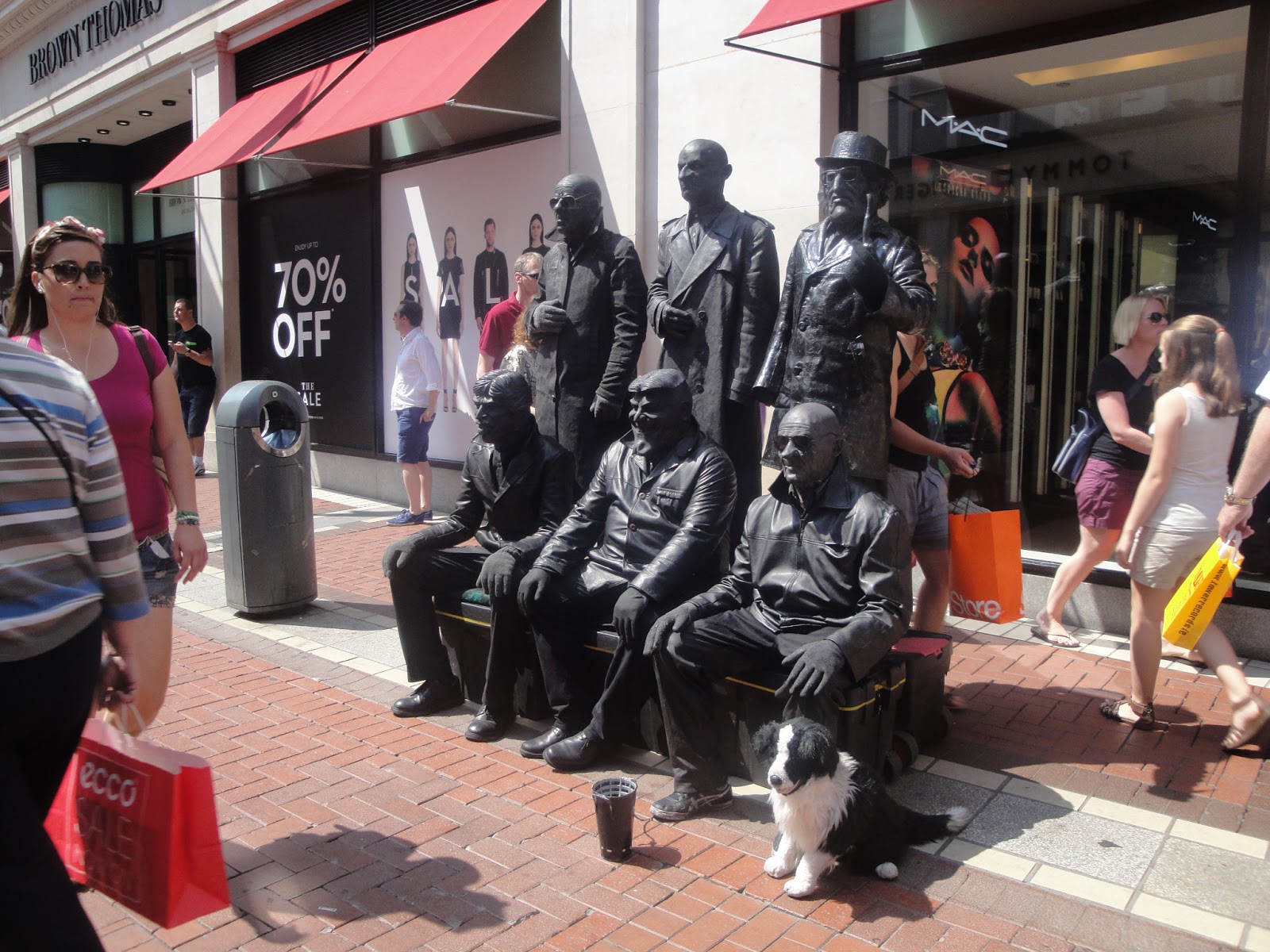
Yes, those are real people. In the hot, hot sun. The dog, however, is fake.

The cool part of Dublin Castle.
By this time it was around 4pm, and we walked to our hostel. On our way, we passed the Millennium Spire, which was really tall but not much else haha. The hostel was bigger than the one in Paris but not quite as nice, and we were in a room with seven other people. It wasn't bad though and felt safe. We were all exhausted so we rested and figured out plans for the evening and the next day. We ate dinner at a bed & breakfast/pub nearby. Our waitresses were Irish and that was fun. We went to bed early (I think 10ish), and, even though the bed wasn't the greatest, I slept wonderfully because I was so tired!

The Millennium Spire.
Sunday morning was another hot, sunny day, even though weather.com had told me it would be in the 60s and cloudy so I'd only brought long-sleeved shirts. It was a very warm day! We had cereal and toast for breakfast, complimentary of the hostel. We were going to go take the tour at the Guinness Storehouse, but two guys in our room told us to do the Jameson tour instead, because it was cheaper and more personal. So we did that and a very true Irishman gave us the tour - he was awesome haha. After the tour, we walked to the Guinness place to see the gift store, but we couldn't even do that unless we went on that tour. And there were soo many tourists there. While we were walking around, we stopped to admire this cool-looking building. An older Irish guy walked up to us and asked if we spoke English, and then explained to us the history of the building. However, his accent was so thick that we couldn't understand what he was saying! We gathered that the building had something to do with washing but that was it.

Walking around Dublin.
By then it was almost 2pm, which was when the National Museum of Ireland was opening. We walked across the river to get to it. It wasn't terribly big and mainly focused on the war periods in Ireland, but it was still really cool. They had a bunch of planes and this really old big ship that had been conserved. We didn't stay long there because we planned on attending Evensong at Christ Church Cathedral at 3:30pm. This church was built by the vikings around 1060. It was so cool! They had some original ruins on the property. Evensong there was really different from the ones I attended in Cambridge. There was no choir or singing; only three priests doing the recitations. There weren't a lot of people in attendance - and most of the ones had only come there as tourists and didn't stay for it all. Afterwards, one of the priests shook our hands and said, "Peace be with you." He seemed happy we were there. It only lasted about 20 minutes. Then we got to look around the church and the crypts underneath (where there was also a gift shop and a little cafe). Technically, I don't think we were supposed to do this because it cost to get in the cathedral and see all of that, but we got in for free because we were attending Evensong! So that was fun. Also, a different Irish priest explained to us the history of the floor tiles and what the designs meant. When we left him, he said, "Cheerio," in his Irish accent! It was pretty awesome haha. Other than that, we didn't hear too many Irish accents! Most people wandering around were tourists.

At the National Museum of Ireland, with the Asgard ship.

Christ Church Cathedral.
We went to this really big souvenir shop and did some browsing. Ireland has so many better souvenirs than England does! We ate at the Long Stone Pub for dinner, and I had a bacon cheeseburger (made with Irish beef). It tasted pretty normal to me haha. By then, it was time to take the long walk back to the ferry! We thought we might be late so we hurried, but we ended up getting there at just the right time. It was still daylight when we boarded the ferry this time (even though it was 9pm), so we were able to watch the sun set from the deck as we said goodbye to Ireland. It was so beautiful! It was super windy and cold up there though, so we didn't stay too long. We arrived back in Wales around 12:30am and, surprisingly, the security guards were briefly looking at everyone's passports. It was weird, but we go in fine. We had to wait four hours for our train...I slept a little bit but not terribly well. The train was another four hours to London, and I was able to sleep then. We arrived at 8:30am, caught the train back to Cambridge, and arrived back a little after 10am Monday morning. It was quite the trip!

Sun setting over Ireland. :)
Friday, July 12, 2013
Cambridge Day Nine, Ten, Eleven, and Twelve (July 8th-11th)
This week was a lot less eventful compared to last week! Monday began with session on The Four Loves by C.S. Lewis. I took a nap in the afternoon and just rested after the exciting weekend. In the evening, we had a lecture on John Milton, specifically about his years here at Cambridge. I went to the grocery store in the evening, and that was pretty much Monday. Tuesday, we had session on Milton's Comus. The Milton scholar who gave the lecture sat in our session too. In the afternoon, Heather and I walked in to town to this bookstore that sells first edition copies of books. It was so cool! We spent a good while in there, just browsing through and marveling at how old the books were (yes, we are English major nerds). I wanted to buy something, but most things were really expensive (anywhere from 50-200 pounds). I'm probably going to go back next week, though, and might get something, depending on how much money I have left haha. There's a big market area in the middle of town, and we spent some time walking around there and browsing. We saw a street performer get on an 8-foot unicycle. For dinner, I went out with some friends to a restaurant called Nando's. We all split a big platter of chicken and sides. It was really yummy.
Wednesday was another London day! We met at the train station at 9am. (I also got my morning exercise in when the group I was with missed our turn for the station and walked a bit too far...then had to run back to make it in time!) We went to the British Museum first, which was really cool! We'd had to read the book Through the British Museum with the Bible before we went, and my group's tour guide was one of the authors! (I got him to sign my book, haha.) We saw the Rosetta Stone, the Black Obelisk, the Cyrus Cylinder. We were there two hours, but there was so much to see! I didn't feel like we even came close to seeing half of it. It was really neat though, because our tour guide was telling us how all of these different artifacts prove the truth of all the historical facts mentioned in the Bible. It was so fascinating! After the museum, we picked up lunch at a Pret store, which sells ready-made food like sandwiches and stuff, and we ate at a nearby park. From there, we walked to the British Library, which was awesome! We saw all the illuminated manuscripts, which included the Magna Carta and some early copies of the Bible (including the Gutenberg Bible), as well as early works of literature and music. There was also a letter from Napoleon to his brother that had been intercepted. From there we were on our own until 7pm. I spent some more time in the Library, just looking around, and then I went with some friends to Baker Street! We were going to go in the Sherlock Holmes Museum, but unfortunately the line was too long and we ended up not having time for it. Instead, we went in the gift store and just looked around there. It was really cool! Then we went to the National Gallery and looked around there for awhile. I'm not a big art person, but some of the paintings were really cool. Next, we went and saw the London Bridge! (No, it wasn't falling down, but we did see the drawbridge go up and down.) The London Bridge was close to the Globe (where we were meeting at 7pm) so we picked up dinner and walked there.


The Globe was awesome! We saw A Midsummer Night's Dream, and it was a lot funnier watching it than when I read it. It was such a neat experience being there and very cool to see Shakespeare how it was meant to be seen. The play lasted until around 10:30pm, and then we had to rush back to the King's Cross Station. There were no more trains going to Cambridge, so we had to take one to another town and then catch a bus to Cambridge. I got back to my room at 1am. Our professors were nice though, and they delayed class Thursday morning until 10:30am. :)

We had session on Tennyson's poem "In Memoriam A.H.H." After session, we all walked over to the Tyndale House, which is this house with a library that has every serious doctrinal work written in it. It only contains books/dissertations/etc. related to the Bible. They also do Bible translation work (from the original Hebrew and Greek). The head of the house (I think), Dr. Peter Williams, gave us a lecture about Bible translations and language. It was really interesting! I got back to my room around 4:30pm and took a nap, then read some. I finished my reading for next Tuesday last night, but I still have one more book to read that is due Wednesday that I get to start and finish this weekend. I'm still having a really good time here; it's hard to believe there's only one week left!
Wednesday was another London day! We met at the train station at 9am. (I also got my morning exercise in when the group I was with missed our turn for the station and walked a bit too far...then had to run back to make it in time!) We went to the British Museum first, which was really cool! We'd had to read the book Through the British Museum with the Bible before we went, and my group's tour guide was one of the authors! (I got him to sign my book, haha.) We saw the Rosetta Stone, the Black Obelisk, the Cyrus Cylinder. We were there two hours, but there was so much to see! I didn't feel like we even came close to seeing half of it. It was really neat though, because our tour guide was telling us how all of these different artifacts prove the truth of all the historical facts mentioned in the Bible. It was so fascinating! After the museum, we picked up lunch at a Pret store, which sells ready-made food like sandwiches and stuff, and we ate at a nearby park. From there, we walked to the British Library, which was awesome! We saw all the illuminated manuscripts, which included the Magna Carta and some early copies of the Bible (including the Gutenberg Bible), as well as early works of literature and music. There was also a letter from Napoleon to his brother that had been intercepted. From there we were on our own until 7pm. I spent some more time in the Library, just looking around, and then I went with some friends to Baker Street! We were going to go in the Sherlock Holmes Museum, but unfortunately the line was too long and we ended up not having time for it. Instead, we went in the gift store and just looked around there. It was really cool! Then we went to the National Gallery and looked around there for awhile. I'm not a big art person, but some of the paintings were really cool. Next, we went and saw the London Bridge! (No, it wasn't falling down, but we did see the drawbridge go up and down.) The London Bridge was close to the Globe (where we were meeting at 7pm) so we picked up dinner and walked there.

Sherlock Holmes Museum

The London Bridge, with the Tower of London on the left.
The Globe was awesome! We saw A Midsummer Night's Dream, and it was a lot funnier watching it than when I read it. It was such a neat experience being there and very cool to see Shakespeare how it was meant to be seen. The play lasted until around 10:30pm, and then we had to rush back to the King's Cross Station. There were no more trains going to Cambridge, so we had to take one to another town and then catch a bus to Cambridge. I got back to my room at 1am. Our professors were nice though, and they delayed class Thursday morning until 10:30am. :)

Inside the Globe.
We had session on Tennyson's poem "In Memoriam A.H.H." After session, we all walked over to the Tyndale House, which is this house with a library that has every serious doctrinal work written in it. It only contains books/dissertations/etc. related to the Bible. They also do Bible translation work (from the original Hebrew and Greek). The head of the house (I think), Dr. Peter Williams, gave us a lecture about Bible translations and language. It was really interesting! I got back to my room around 4:30pm and took a nap, then read some. I finished my reading for next Tuesday last night, but I still have one more book to read that is due Wednesday that I get to start and finish this weekend. I'm still having a really good time here; it's hard to believe there's only one week left!
Monday, July 8, 2013
Paris Weekend! (Day Six, Seven, and Eight; July 5th-7th)
Friday began with session on Charles Simeon's sermons on Galatians. We had session in Holy Trinity Church, the church that Simeon preached at for fifty years, which was really cool to be in after just reading all about him. After session, we were free for the weekend, and three of my friends and I had decided previously to travel to Paris for the weekend. Our bus didn't leave until 6:30pm, so we had the afternoon to pack and get ready to go. We took a bus from Cambridge to London and then caught a connecting bus straight to Paris. When it was time to board that bus, there was a mad rush to get on the bus (British people don't form lines to get on buses), but God was on our side and we found four seats open in the very last row of the bus. The bus left London around 10:30pm, and I dozed on and off until we got to Dover - and even though it was dark outside, we could still see the enormous cliffs! That was cool. At Dover, we had to get off the bus and go through customs to cross the English Channel into France. Going through French customs was a lot different than UK customs - the French barely looked at our passports before they stamped them and let us through. After that we got back on the bus and waited to board the ferry. Our bus drove onto a lower level of the ferry, and then we had to get off because we weren't allowed to be on the bus during the ferry ride. Unfortunately, I forgot to bring my camera with me off the bus, so I didn't get any pictures of the ferry. But it was really big and there was a food court and a bunch of comfy chairs and couches. We went outside on top, and the view was beautiful even though it was dark. It was really cold though, so we went back inside and slept (it was around 2am). When we woke up, we could see France from the windows (still dark though)! We got back on the bus and the bus drove off the ferry and we continued on our merry way. We were in Calais, France and it was now around 4am. We all were able to sleep during this leg of the journey, which was good. We finally arrived in Paris about 7:30am!

Upon arriving, we set out to find a map and figure out how to get somewhere. We bought 2day bus passes and decided to head to Notre Dame and find food along the way. We had a bit of confusion with the bus stop and getting the right bus though, and we ended up getting helped by an Italian lady who spoke French and English (and who knows what else haha). We chatted with her while we waited for the bus, and when she found out that we were Americans, she got so excited and fell in love with us! It was so funny! She even touched all of us just because she wanted to touch Americans. She got even more excited when we said we were from California (which is ironic because none of us were actually from California - two Georgians and two Washingtonians). She didn't say why she was in Paris, but she told us she didn't like French weather or food. (The weather, however, was hot and sunny! It was a beautiful day to us.) She specifically told us not to eat French pizza. We told her all that we were doing, and she was impressed with Nathan's French (he's the only one of us who could speak more than a few words). The bus finally came, and she shook all of our hands in farewell. It was quite the welcome to Paris!
The bus took us into more of the center of Paris, and we got off and found a little food place that had croissants and omelets. The guy we ordered from though wasn't French and he preferred to speak to us in English rather than French, which was kinda funny. But we got breakfast and some energy which was the important thing (it was around 10am by this point). We found a Starbucks with free wifi and free water. Then we found the Notre Dame! It was amazing! SO gorgeous and we took a ton of pictures. We were a little worried of the really long line to get inside, but it moved quickly and only took us about 15 minutes. Once inside, we were supposed to be silent because there was a Mass going on, but people were still being noisy. We took our time walking all the way through the building and just taking everything in; it was really quite stunning. When we got back outside, we walked around the outside of the building and crossed one of the Bridges of Locks over the Seine River. I'm pretty sure this is the bridge that Cat's lock is on, but there was no way I would have been able to find it without knowing exactly where it was - the bridge was completely covered in locks!


We sat down at a park and determined to find the Shakespeare and Company bookstore. I had the address and knew it was near the Notre Dame, but we could not find it on the bus map we had. We finally just decided to start walking, and turns out the bookstore was on the other side of the park! Favorite bookstore ever. It was so cool!! Really tiny, crowded space but so many cool, old books. It has a library upstairs with even older books that you can sit and read while you're there, but you're not allowed to take them out. There's even a little old piano up there that you can play! We stayed there for a long while. It was just so wonderful.
It was now around 2pm, and we decided to try to find our hostel (check-in time was 3pm). We had trouble finding the right bus stop that we needed (for some reason, they were never were the map made us think they would be). We ended up walking to the Louvre before we found the right one. We didn't stay at the Louvre then though, because we were going to go the next day when it was free. We made it to the hostel just fine, and I got my first glimpse of the Eiffel Tower from the bus! The hostel was actually a pretty nice place, for a hostel. Narrow hallways and not a very big room, but big enough for two bunk beds, a desk, and two chairs. We also had our own very tiny bathroom. Our window looked out on the street. We rested there for a while and freshened up (walking around Paris in the very hot sunshine while carrying around our backpacks means that, yes Liz, I was once again sweaty, haha). We asked the lady who checked us in where a good place to eat would be, but she told us she didn't know! So we decided to head for the Eiffel Tower and just see what we could find around there. I absolutely loved the Eiffel Tower! It was so amazing!! We stayed at its base for awhile and just marveled at its beauty (and took lots of pictures). It was so surreal to be there but really really cool. We were planning on going to the top, but we wanted to eat first. We walked to Rue Cler street and ate at a crepe place. We each got a dinner crepe (I had ham, eggs, and cheese in mine) and then got a Nutella and strawberry crepe to split. It was sooo yummy!

This couple sat next to us who were from a town in Idaho close to Spokane, Washington, where Heather is from. So we chatted with them for a while (the service was slow at the crepe place, but our waiter was a little old man and he was really funny). It was 8pm by the time we left. We walked back to the Eiffel Tower and took a lot more pictures. Unfortunately, the line to buy tickets up to the top was really long, and there was a wait time of 45 minutes just to get from the second floor to the top. Since we were all tired and we didn't know how late the buses ran (it would be a long walk back to the hostel), we decided not to go up. Which just means that I have to go back someday! I really loved the Eiffel Tower. We took a bus back to our hostel around 9:30pm, read Galatians out loud together (since we're supposed to be reading it every day; I don't know if I've said that or not), and then got ready for bed. Heather and I used the computer in the main lobby to get online, but the French keyboard tripped us up for a bit! It took me 5-10 minutes just to figure out how to type the @ symbol! It was funny. Even though there was no AC in our room and it was really hot, I slept well because I was just so exhausted from the day.


Sunday morning, we ate the free breakfast at the hostel (croissants, jam, and orange juice or coffee) and then headed to the Louvre! The Louvre is only free the first Sunday of each month, so we had planned our Paris trip this weekend so that we could get in free. It opened at 9am, but we got there at 8am because we assumed the line would be long. We then sat down in the line and read for an hour (like the good Torrey students that we are), and when we stood back up, the line had multiplied by like a thousand, haha. It was so long! We were able to get inside pretty much right away though because we'd gotten there so early. Once inside, we were thankfully able to check our backpacks into a baggage place there so we didn't have to carry them all around the museum. We decided to find the Mona Lisa first, but the museum is so big and, even though we had maps, really confusing. And of course we got distracted by everything else along the way (because everything is so cool!) so it took us awhile to find the Mona Lisa. It was clear when we were finally getting close though, because the crowd went from non-existent to very full. They don't let you get close to the painting and there's glass around it, but it was really cool to see it. We then decided to split up since we all probably didn't want to see the same things. I saw so many cool things! The Venus statue, the Sphinx, the Code of Hammurabi, the winged Victory statue, the medieval Louvre, so many cool intricately painted ceilings. The building itself is an amazing work of art. The only unfortunate thing was that most of the descriptions about the art were in French and we didn't purchase the audio guides, so I didn't really learn anything. But it was all still really cool and absolutely beautiful.


We all met back up around noon and went to the gift shop to buy souvenirs. Then we had to find the bus stop to take us to the Eurolines bus station and head back to London. This took forever! The bus stop was not where the map said that it was (at least not that we could find) and we had to walk a ways before we found it. We had wanted to get to the bus station at 1pm (two hours before our bus left) but we didn't get there until 1:45. We decided we had time to get some food then anyways, but unfortunately, the only thing open in the mall right next to the station was the McDonalds. But I guess it was fitting that we ate French fries in France. :) We made it to our bus with plenty of time to spare though, around 2:30pm. The bus didn't end up leaving until 3:30 though. Instead of the ferry this time, our bus took the Eurotunnel underneath the channel. Before we got on, we had to pass through the British customs, and the guy I had kept asking me the same questions about my traveling plans! They were so interrogating to all of us. I really don't think they like getting foreigners...haha. The tunnel itself was so weird because we were on a bus on a train in a tunnel under water! We were allowed to get off the bus during the ride, but the only thing on the train was other cars. It was a cool experience, but I liked the ferry better, even though the tunnel only took about 30 minutes. We got to London an hour behind schedule (10:30pm) and had just enough time to catch our connecting bus to Cambridge, which left at 11pm. We made it back at 12:45am. What a crazy weekend! It was so much fun though, and I'm so blessed that God worked out all of the details and kept us (and our passports) safe. My mother's prayer were answered. :) It was an exhausting weekend, but I wouldn't take it back for anything.

On the bus heading to Paris!
Upon arriving, we set out to find a map and figure out how to get somewhere. We bought 2day bus passes and decided to head to Notre Dame and find food along the way. We had a bit of confusion with the bus stop and getting the right bus though, and we ended up getting helped by an Italian lady who spoke French and English (and who knows what else haha). We chatted with her while we waited for the bus, and when she found out that we were Americans, she got so excited and fell in love with us! It was so funny! She even touched all of us just because she wanted to touch Americans. She got even more excited when we said we were from California (which is ironic because none of us were actually from California - two Georgians and two Washingtonians). She didn't say why she was in Paris, but she told us she didn't like French weather or food. (The weather, however, was hot and sunny! It was a beautiful day to us.) She specifically told us not to eat French pizza. We told her all that we were doing, and she was impressed with Nathan's French (he's the only one of us who could speak more than a few words). The bus finally came, and she shook all of our hands in farewell. It was quite the welcome to Paris!
The bus took us into more of the center of Paris, and we got off and found a little food place that had croissants and omelets. The guy we ordered from though wasn't French and he preferred to speak to us in English rather than French, which was kinda funny. But we got breakfast and some energy which was the important thing (it was around 10am by this point). We found a Starbucks with free wifi and free water. Then we found the Notre Dame! It was amazing! SO gorgeous and we took a ton of pictures. We were a little worried of the really long line to get inside, but it moved quickly and only took us about 15 minutes. Once inside, we were supposed to be silent because there was a Mass going on, but people were still being noisy. We took our time walking all the way through the building and just taking everything in; it was really quite stunning. When we got back outside, we walked around the outside of the building and crossed one of the Bridges of Locks over the Seine River. I'm pretty sure this is the bridge that Cat's lock is on, but there was no way I would have been able to find it without knowing exactly where it was - the bridge was completely covered in locks!

Notre Dame

Inside the Notre Dame.
We sat down at a park and determined to find the Shakespeare and Company bookstore. I had the address and knew it was near the Notre Dame, but we could not find it on the bus map we had. We finally just decided to start walking, and turns out the bookstore was on the other side of the park! Favorite bookstore ever. It was so cool!! Really tiny, crowded space but so many cool, old books. It has a library upstairs with even older books that you can sit and read while you're there, but you're not allowed to take them out. There's even a little old piano up there that you can play! We stayed there for a long while. It was just so wonderful.
It was now around 2pm, and we decided to try to find our hostel (check-in time was 3pm). We had trouble finding the right bus stop that we needed (for some reason, they were never were the map made us think they would be). We ended up walking to the Louvre before we found the right one. We didn't stay at the Louvre then though, because we were going to go the next day when it was free. We made it to the hostel just fine, and I got my first glimpse of the Eiffel Tower from the bus! The hostel was actually a pretty nice place, for a hostel. Narrow hallways and not a very big room, but big enough for two bunk beds, a desk, and two chairs. We also had our own very tiny bathroom. Our window looked out on the street. We rested there for a while and freshened up (walking around Paris in the very hot sunshine while carrying around our backpacks means that, yes Liz, I was once again sweaty, haha). We asked the lady who checked us in where a good place to eat would be, but she told us she didn't know! So we decided to head for the Eiffel Tower and just see what we could find around there. I absolutely loved the Eiffel Tower! It was so amazing!! We stayed at its base for awhile and just marveled at its beauty (and took lots of pictures). It was so surreal to be there but really really cool. We were planning on going to the top, but we wanted to eat first. We walked to Rue Cler street and ate at a crepe place. We each got a dinner crepe (I had ham, eggs, and cheese in mine) and then got a Nutella and strawberry crepe to split. It was sooo yummy!

The Nutella and strawberry crepe.

My reaction upon seeing the Eiffel Tower up close.

Heather, Scott, Nathan, and I underneath the Eiffel Tower.
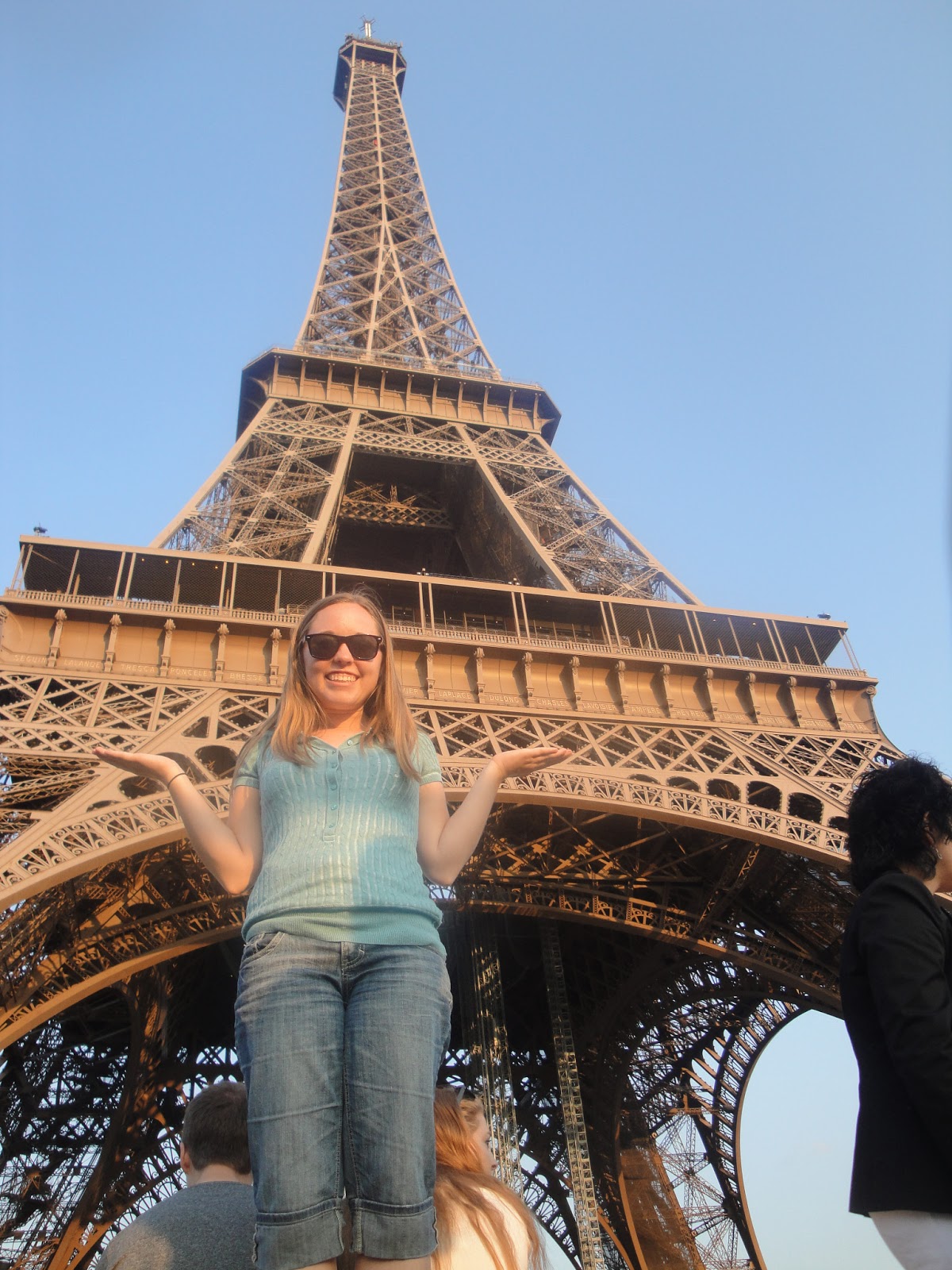
The Eiffel Tower!
Sunday morning, we ate the free breakfast at the hostel (croissants, jam, and orange juice or coffee) and then headed to the Louvre! The Louvre is only free the first Sunday of each month, so we had planned our Paris trip this weekend so that we could get in free. It opened at 9am, but we got there at 8am because we assumed the line would be long. We then sat down in the line and read for an hour (like the good Torrey students that we are), and when we stood back up, the line had multiplied by like a thousand, haha. It was so long! We were able to get inside pretty much right away though because we'd gotten there so early. Once inside, we were thankfully able to check our backpacks into a baggage place there so we didn't have to carry them all around the museum. We decided to find the Mona Lisa first, but the museum is so big and, even though we had maps, really confusing. And of course we got distracted by everything else along the way (because everything is so cool!) so it took us awhile to find the Mona Lisa. It was clear when we were finally getting close though, because the crowd went from non-existent to very full. They don't let you get close to the painting and there's glass around it, but it was really cool to see it. We then decided to split up since we all probably didn't want to see the same things. I saw so many cool things! The Venus statue, the Sphinx, the Code of Hammurabi, the winged Victory statue, the medieval Louvre, so many cool intricately painted ceilings. The building itself is an amazing work of art. The only unfortunate thing was that most of the descriptions about the art were in French and we didn't purchase the audio guides, so I didn't really learn anything. But it was all still really cool and absolutely beautiful.

The Louvre Museum

The really long line (this was actually part of the "beginning" of the line).
We all met back up around noon and went to the gift shop to buy souvenirs. Then we had to find the bus stop to take us to the Eurolines bus station and head back to London. This took forever! The bus stop was not where the map said that it was (at least not that we could find) and we had to walk a ways before we found it. We had wanted to get to the bus station at 1pm (two hours before our bus left) but we didn't get there until 1:45. We decided we had time to get some food then anyways, but unfortunately, the only thing open in the mall right next to the station was the McDonalds. But I guess it was fitting that we ate French fries in France. :) We made it to our bus with plenty of time to spare though, around 2:30pm. The bus didn't end up leaving until 3:30 though. Instead of the ferry this time, our bus took the Eurotunnel underneath the channel. Before we got on, we had to pass through the British customs, and the guy I had kept asking me the same questions about my traveling plans! They were so interrogating to all of us. I really don't think they like getting foreigners...haha. The tunnel itself was so weird because we were on a bus on a train in a tunnel under water! We were allowed to get off the bus during the ride, but the only thing on the train was other cars. It was a cool experience, but I liked the ferry better, even though the tunnel only took about 30 minutes. We got to London an hour behind schedule (10:30pm) and had just enough time to catch our connecting bus to Cambridge, which left at 11pm. We made it back at 12:45am. What a crazy weekend! It was so much fun though, and I'm so blessed that God worked out all of the details and kept us (and our passports) safe. My mother's prayer were answered. :) It was an exhausting weekend, but I wouldn't take it back for anything.
Subscribe to:
Posts (Atom)